Comparison workspace
The machines, side by side.
Select up to four models. Compare their specifications, integration options, and commercial context — and keep the unknowns in view.
| Model intelligence | PUDU Robotics D7 (2024 first generation) |
|---|---|
| Model profile | 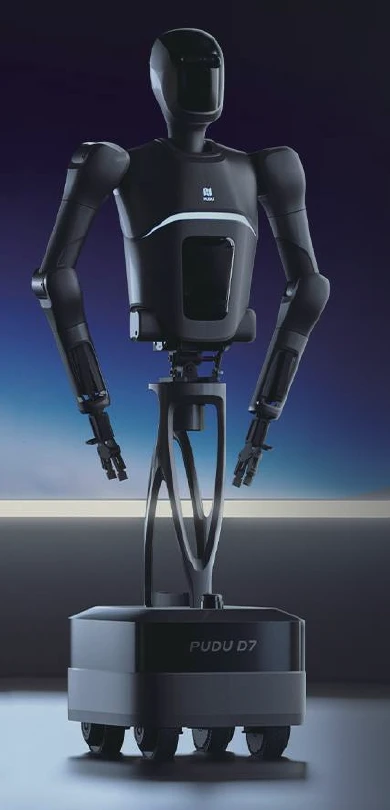 Explore D7 (2024 first generation) ↗ |
| Status | Announced |
| Readiness score | Unscored |
| Payload | Unknown |
| Runtime | Unknown |
| SDK/API | No inspected current original-D7 SDK/API, firmware, ROS or simulation mapping. Later 2026 toolchain and general PUDU Android APIs do not establish compatibility or entitlement on historical hardware. |
| Programming | Exact humanoid SDK/API package and licence require manufacturer confirmation; No exact-model ROS distribution or maintained bridge verified |
| Compliance | CE marking: Unknown |
| EU readiness | Unknown |
| Lead time | Needs verification |
| EU support | China, Europe via subsidiary/channel arrangements, US/Canada, Japan and other overseas support contacts |
| Last verified | Nov 2, 2026 |
| Factory fit | The first D7 launched September 19, 2024 as a 1650 mm / 45 kg semi-humanoid on an omnidirectional base. Manufacturer gives 30 body DOF, or 50 with a hand attachment, 650 mm arm reach and more than eight hours endurance. These describe the original platform, not the 140 kg 2026 industrial redesign. |